
New Airbnb rules in 2026: what owners and concierge businesses can no longer ask guests to do

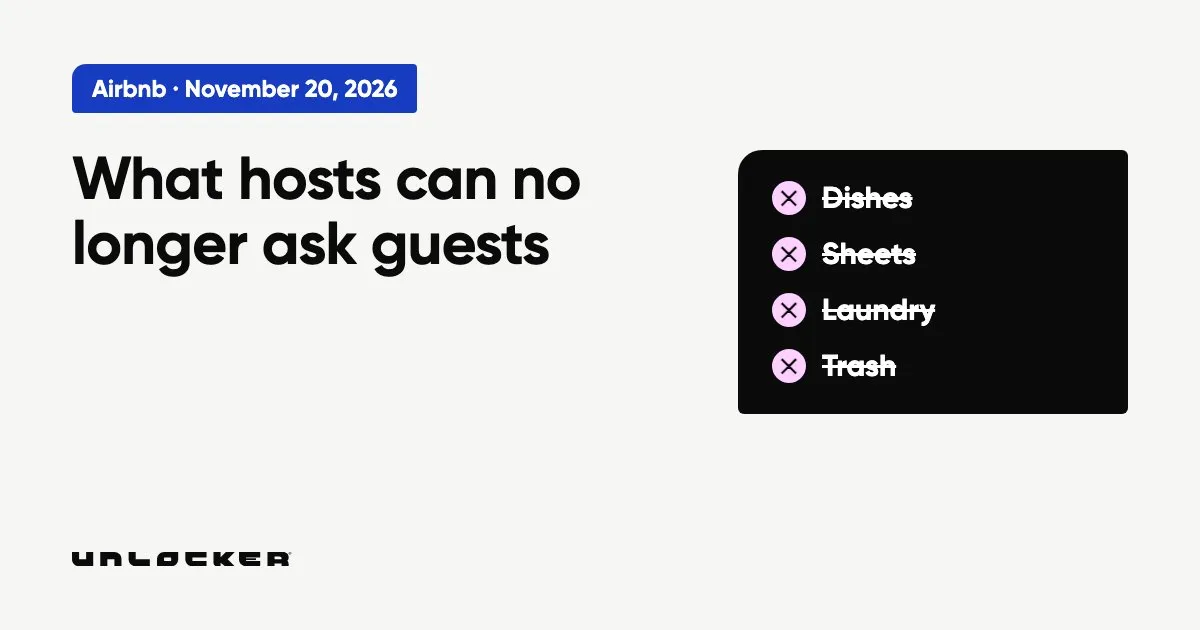
For every reservation booked on or after November 20, 2026, Airbnb no longer lets hosts ask guests to wash dishes, strip the bed, start a load of laundry or take the trash out of the home. Simple requests are still allowed: dishes in the sink, used towels gathered, trash sorted.
Airbnb announced the change to hosts on October 20, 2026, one month before it takes effect. For a concierge business, it hits three things at once: listings to fix, cleaning time at every checkout, and the margin on every turnover.
This article covers what changes, what happens if you do nothing, and how to adapt your operations. It is part of our guide to help you grow your concierge business.
What changes on Airbnb on November 20, 2026?
The reference text is called “Reasonable house rules and requests”. It applies to all reservations booked on or after November 20, 2026. The booking date is what counts, not the arrival date: a December stay booked in October is not affected.
Three changes matter for hosts and concierge businesses:
- One place for all rules. House rules and checkout instructions now live together in the listing editor. Checkout instructions no longer have their own tab.
- Seven standard rules. Hosts choose from: maximum overnight guests, quiet hours, events, pets, smoking, commercial photography, and locking up at checkout. They can add requests, as long as those requests are reasonable.
- Everything is disclosed before booking. A rule or request added elsewhere on the listing page, or sent after booking, does not comply with Airbnb’s policy.
This is a platform policy, not a change in the law. The legal framework for short-term rentals in France, covered in our article on Airbnb regulation for concierge businesses, stays the same.
Dishes, sheets, trash: what is still allowed?
Airbnb gives the examples itself. The principle: guests should not have to do tasks that take significant effort or time and that a cleaner would normally handle.
| Topic | Can no longer be requested | Still allowed |
|---|---|---|
| Dishes | Washing and putting away dishes | Putting used dishes in the sink |
| Laundry | Stripping the bed, starting a load of laundry | Gathering used towels |
| Trash | Taking trash off-site | Sorting trash into the designated indoor bins |
| Amenities | Avoiding a listed amenity, such as air conditioning | Turning amenities off when leaving |
The policy also bans fining or penalizing guests, restricting access to an advertised amenity, asking guests to sign a separate contract, or asking for a government ID, unless required by law and in other limited circumstances.
Exceptions remain possible depending on local conditions. Airbnb’s example is limiting shower time during drought-related water restrictions.
What happens to a listing that keeps its old checkout instructions?
Airbnb applies a step-by-step escalation:
Flag in the listing editor
Non-compliant requests are highlighted in the listing editor, with a tip on how to fix them.
Email to the host
The host receives an email with tips to comply and the option to appeal if they disagree.
Alert visible to guests
If the issue persists, the listing may show an alert such as "includes cleaning requests".
Reduced visibility
Persistent violations can reduce the listing's visibility in search results.
For a concierge business managing twenty listings, a “cleaning requests” alert on just one of them is visible to guests and to the owner. The safest move is to fix every listing before November 20, without waiting for the first flag.
Cleaning fees: who pays the difference?
The new policy does not touch cleaning fees: neither the policy nor the announcement to hosts changes them. What changes is the work required at each checkout.
The tasks guests will no longer do fall to the cleaning team: stripping the bed, washing and putting away dishes, taking out the trash. Time per turnover goes up. Someone has to carry that extra cost, and there are three options:
- The concierge business absorbs it. The price stays the same, the margin per turnover drops.
- The guest pays it. Cleaning fees go up. Airbnb requires the price shown to guests to be the total price, so the increase is visible in search results and can weigh on bookings.
- The owner covers it. The concierge business renegotiates its pricing or its mandate, with numbers to back it up.
No option is right by default. Choose property by property, based on the time actually added to each cleaning, measured with your cleaning providers.
What does it mean for owners and concierge businesses?
For owners
- House rules to review on every listing
- Cleaning fees or net income that may change
- A risk of a visible alert on the listing if nothing is fixed
For concierge businesses
- Longer cleaning time at every checkout
- Cleaning provider contracts and rates to review
- Pricing and mandates to update with owners
The main risk for a concierge business is discovering the extra cost too late, on December’s cleaning invoices. The provider bills the actual time, the owner expects the same income, and the gap comes out of the commission.
How to adapt your business before November 20?
Review every listing in the new editor
Non-compliant requests are already flagged there: it is the most reliable to-do list.
Rewrite checkout instructions
Replace each banned task with its allowed version: dishes in the sink, towels gathered, trash sorted, amenities turned off.
Remove instructions sent after booking
Automated messages, house manuals, signs: anything that adds a rule outside the listing has to go.
Measure the extra cleaning time
With your cleaning providers, measure the time added per turnover, property by property.
Update your pricing with owners
Show the extra cost in numbers and agree on who carries it, before the first affected bookings.
Why reduce your dependence on platforms?
Between the October 20 announcement and the November 20 start date, hosts had one month to adapt. A platform sets its own rules, and a concierge business that relies on a single channel absorbs every change in its costs.
What you control are your money flows: what the owner pays, what you invoice, what your cleaning providers receive. With split payment, every payment is split on receipt between the owner, your commission and your providers. A higher cleaning fee then flows through automatically on every payout, with no invoice to redo and no reminders to send. Split payment is available from €50 excl. VAT per month, with no volume commitment.
To see what it costs for your properties, check our split payment pricing.
- Airbnb — Règlement intérieur et demandes raisonnables — verified on October 28, 2026
- Airbnb — Changements importants apportés au règlement intérieur (annonce aux hôtes du 20 octobre 2026) — verified on October 28, 2026
- Airbnb — Tarification et transparence des paiements — verified on October 28, 2026
Chloé Roca has been Unlocker's Head of Communications since September 2023, and has been an investor in the company since 2022. A digital communications specialist (Bachelor's from ESCM Strasbourg, Master's in project management from TIHS), she draws on several years in digital marketing and communications to raise Unlocker's profile among rental professionals.
Frequently asked questions
When do the new Airbnb rules apply?
To all reservations booked on or after November 20, 2026. The booking date is what counts: a stay booked before that date keeps the rules in place when it was booked.
Can an Airbnb host still ask guests to wash the dishes?
No, hosts can no longer ask guests to wash and put away dishes. They can ask guests to put used dishes in the sink.
Are Airbnb cleaning fees being removed?
No. The new policy does not change cleaning fees. It limits the tasks hosts can ask guests to do at checkout.
What happens if a listing keeps banned checkout instructions?
Airbnb flags the request in the listing editor and emails the host. If nothing changes, the listing may show an "includes cleaning requests" alert and lose visibility in search results.
Grow Your Concierge Business: Find, Win and Retain Property Owners
Prospecting, retention and automation in a single guide.
More on Grow your concierge business
All Grow your concierge business articles


Your cleaning fees change, your payouts follow
Every payment split on receipt between the owner, the concierge business and providers. Split payment from €50 excl. VAT per month, no volume commitment.