
Airbnb Regulation: Why Concierge Companies Need to Get Structured


Brussels is preparing new tools to rein in Airbnb, Booking and other short-term rental platforms, and France has had its own law on the subject since November 2024. If your concierge business lives off short-term rentals, this crackdown is no longer a distant maybe. Getting ahead of it is a must if you want to grow your concierge business for the long run.
What’s already been voted
Two texts already set the framework.
In France, Law No. 2024-1039 of November 19, 2024, known as the Le Meur Law, strengthens tools for regulating tourist rentals at the local level. It requires every property to be registered with a national online service, lets municipalities cut the number of rental days (down to a 90-day minimum), and creates a specific tax regime for professional tourist rental operators.
At the European level, Regulation (EU) 2024/1028 has required more transparency from platforms since 2024. They must verify the registration number of listings in regulated areas, and send their activity data (nights booked, number of guests, country of residence) every month to each member state’s digital entry point. Full application is delayed by about two years after it entered into force.
What’s coming from Brussels
For the European Commission, this transparency framework isn’t enough on its own. A new legislative initiative on short-term rentals is part of its affordable housing plan announced in late 2025, with the stated goal of better supporting the areas under the most housing pressure.
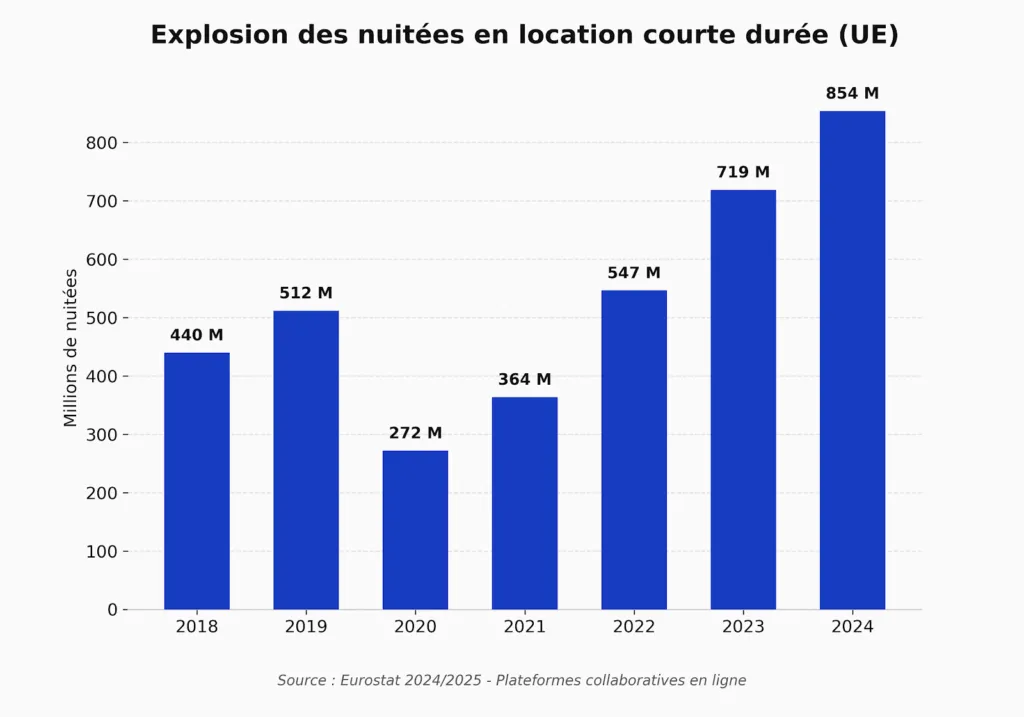
The numbers behind the push are clear. According to Eurostat, nights booked through online platforms in Europe went from 512 million in 2019 to 952 million in 2025, an increase of more than 85% in six years. For Brussels, short-term rental has gone from an occasional use between individuals to a structured economic activity that directly affects housing availability.
The Spanish signal
This pressure is no longer just regulatory. You can already see it in local decisions. In Spain, the mayor of Barcelona announced that the city won’t renew any of its roughly 10,000 tourist housing licenses when they expire in November 2028, which puts those homes back on the residential market. Even the big platforms aren’t safe: Spain’s competition authority (CNMC) fined Booking.com €413.24 million for abusing its dominant position against Spanish hotels.

What it means for your concierge business
Platforms are on the front line, but concierge companies are directly affected too. A stricter framework means less tolerance for gray areas, more inspections and local rules that keep shifting.
Collecting money on behalf of owners without a valid carte G delegation (carte G is the French property management license), mixing up financial flows, or depending on a single platform is an increasingly risky bet. These practices aren’t necessarily banned everywhere, but they become fragile, hard to defend in an inspection, and impossible to value if you ever want to sell your portfolio. What a management portfolio is really worth covers that topic well.
Getting structured becomes your competitive edge
Faced with this crackdown, two kinds of concierge companies will coexist: the ones that put up with the new rules, and the ones that got ahead by securing their financial flows and clarifying their legal position. The second group also diversifies its revenue, for example by adding long-term rental management alongside short-term.
But as soon as you intermediate or manage on behalf of a third party, the legal framework is demanding. Without the right structure, diversifying quickly turns into a headache. With a compliant framework, it becomes a lever to secure the future of your business. That’s the whole point of getting everything structured before you reach 20 properties.
Where Unlocker fits in this context
Unlocker lets concierge companies operate within this stricter framework without improvising. On the banking side, you stay compliant by keeping financial flows separate through split payment. On the legal side, you grow into long-term rental through carte G delegation, explained in this guide.
The real question is no longer whether the rules will change, but whether your model is structured enough to adapt without suffering from them. Concierge companies that professionalize now get a head start. The others risk seeing their growth stopped by a framework they didn’t see coming.
- Loi n° 2024-1039 du 19 novembre 2024 visant à renforcer les outils de régulation des meublés de tourisme à l'échelle locale (Légifrance) — verified on September 26, 2026
- Règlement (UE) 2024/1028 relatif à la collecte de données sur les services de location de courte durée (EUR-Lex) — verified on September 26, 2026
- Commission européenne — un plan pour un logement plus abordable en Europe (décembre 2025) — verified on September 26, 2026
- Eurostat — Tourism nights booked via platforms hit nearly 1 billion — verified on September 29, 2026
- CNMC (Espagne) — sanction de Booking.com pour abus de position dominante — verified on September 26, 2026
- Idealista — Barcelone met fin aux licences de logements touristiques en 2028 — verified on September 26, 2026
Rachel Stehlin has been Legal Services Manager at Unlocker since September 2022. A lawyer by training, with a master's degree in law from the University of Haute-Alsace, she spent more than 13 years as a court-appointed delegate for the protection of adults under guardianship. At Unlocker, she handles legal questions around rental management and the carte G (the French property management license).
Grow Your Concierge Business: Find, Win and Retain Property Owners
Prospecting, retention and automation in a single guide.
More on Grow your concierge business
All Grow your concierge business articles


8 hours of property management training, free
For concierge companies that want to master the fundamentals.